

Why Enterprise AI Needs More than Just Better Design
This is a headline lorem ipsum.
This is a headline lorem ipsum.
Nobody calls me to admire a system that’s working.
I’ve spent a little over two decades in enterprise product design — telecommunications, energy, healthcare, large-scale SaaS — and in that time my role has narrowed into something specific. I’m the outside expert who gets the call after the problem surfaces. To review the deck that didn’t land. To audit the architecture that quietly drifted. To trace the cost overrun back to its actual source.
So I’ve developed a strange professional intimacy with failure. I don’t see the optimistic kickoff. I see the inheritance — the thing already on fire by the time the phone rings.
My colleague Ralf Gehrig always says that in an age of effortless speed, the real differentiator is discipline. He’s right. But I’d add one thing from the enterprise trenches: discipline must be systematic with AI agents executing in the build pipeline. Meaning, discipline can no longer live only in the designer’s head. Agents don’t have judgment. They have instructions. So the discipline has to move out of the practitioner and into the architecture itself — encoded, governed, machine-readable.
That shift is the whole story. And the four fires I keep walking into are all the same fire, burning in the same place: the absence of an architecture that governs what gets built.

I INHERIT A DESIGN SYSTEM EVERYONE IS STILL TRYING TO FIX
Years ago, I sat across from the head of sales operations at one of the largest telecom carriers in the world, building a unified sales intelligence platform. The screens were good. Then he asked what the interface did when two subsidiaries were in active merger review while one of them was simultaneously mid-provision on a new contract.
I did not have a screen for that. Nobody had told me that state existed. There were eleven more conditions like that.
A design system is a library of answers to questions a human already thought to ask. But every enterprise runs on the states nobody named. A human builder hits one and asks a question. An agent doesn’t ask — it builds something, confidently, instantly, and wrong. The system wasn’t decaying, the comforting word that implies a refactor will fix it. It was obsolete. The polish was never the problem. The gaps were the problem — and agents find every gap you left.
→ Your Design System Is Not Decaying. It’s Obsolete.
I INHERIT AN AGENT WITH NO CONSTITUTION
A health insurer I worked with had four product squads — commercial, Medicare Advantage, Medicaid, and employer group — each owning an eligibility surface. Three had quietly forked from the central design system, because it was built for commercial display logic and couldn’t represent a Medicaid redetermination state. Then a regulatory update landed, and one forked view began showing a lapsed member as active.
That’s not a visual bug. That’s claims liability and compliance exposure, shipped at the speed of a deploy.
The instinct in the room is always give the agents better access to the design system. But the component library was never the missing piece. An agent handed a button and a color token still has no idea what a redetermination state is, or why getting it wrong is a regulated event. What it needs isn’t a richer library — it’s a constitution: a machine-readable set of rules about what is true, what is forbidden, and what each state means in consequence. Agents don’t need more assets to assemble. They need laws they cannot break.
→ AI Doesn’t Need a Better Design System. It Needs a Constitution.
I INHERIT AN OPERATOR IN THE EIGHTH HOUR
This is the failure that haunts me most, because the code was flawless.
A commodity trading operation. An operator eight hours into a shift, scanned a dense grid of vessel and terminal statuses. One terminal status resolved to the wrong visual weight — same as every other cell, because the architecture never encoded the distinction as meaningful. The operator’s eye slid past it. The vessel routed to a closed terminal. The demurrage clock started. A six-figure liability from a single missed signal in an otherwise perfect system.
A governed system can still fail the human sitting in front of it. We borrowed consumer-grade ideas — delight, minimalism, “clean” — and applied them to industrial problems where someone stares at one screen for 10 hours and any missed signal is a real number on a real invoice. The metric that matters here isn’t delight. It’s how long an operator can hold peak precision before fatigue starts manufacturing errors.
In the enterprise, friction is not an annoyance. It is a direct threat to margin.
I INHERIT A HANDOFF THAT’S STILL A SCREEN
So I’ll walk into all of the above, and someone hands me the proposed fix. It’s a Figma file. Beautiful redlines. Annotated screens, ready for engineering.
In an agentic pipeline, that file isn’t a deliverable. It’s a liability waiting for an interpreter — and the interpreter is now a machine that doesn’t interpret. It executes.
The new deliverable doesn't look like a screen at all. It looks like a document — markdown, a constraint file, what I call the Semantic Handoff — a spec the agent runs against rather than a picture a developer reads from. The design handoff doesn't get more organized. It gets replaced. The architect's value moves from producing the surface to authoring the law the surface is generated from.
The human role doesn’t disappear — it shifts from operating surfaces to governing what agents produced. EXA calls this the Reviewer Interface, purpose-built for one job: validating agentic output against the specification. Build it wrong and the human in the loop is ceremonial. Build it right and one architect governs everything fifty squads will ever ship.
Lorem ipsum dolor sit amet, consetetur sadipscing elitr, sed diam nonumy eirmod tempor invidunt ut labore et dolore magna aliquyam erat, sed diam voluptua. At vero eos et accusam et justo duo dolores et ea rebum. Stet clita kasd gubergren, no sea takimata sanctus est Lorem ipsum dolor sit amet.
This is a headline lorem ipsum.
This is a headline lorem ipsum.
FOUR FIRES. ONE DISCIPLINE.
Name the pattern and the four stop being separate problems. The unnamed state, the missing constitution, the eighth-hour miss, the screen-as-handoff — each is a place where what should be built was never encoded anywhere an agent could obey it.
I've named the work I do Enterprise Experience Architecture, or EXA. The four sections above map directly onto its three governing disciplines — which is not a coincidence. Each section is a pillar forming the foundation of the EXA framework.
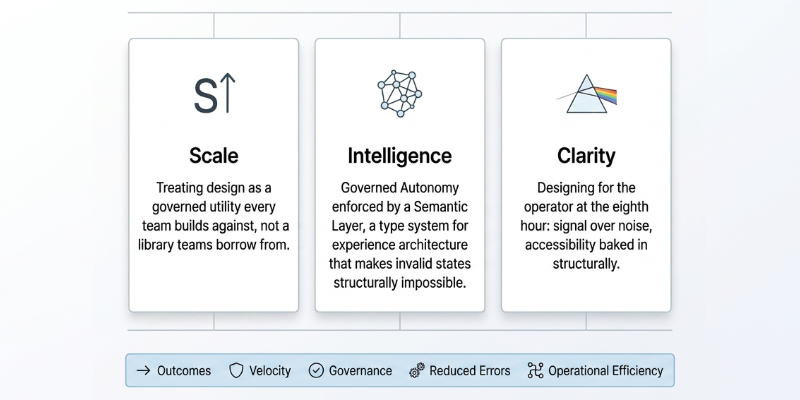
Scale is the first pillar — treating design not as a library teams borrow from, but as a governed utility every team builds against. The telecom carrier’s eleven unnamed states were a Scale failure: institutional logic that lived in people’s heads and died when those people walked out the door, unreachable by any agent, unenforceable at any speed.
Intelligence is the second — Governed Autonomy, enforced by a Semantic Layer that encodes not just what components look like, but why they behave as they do. In software engineering terms, it's a type system for experience architecture — one that makes invalid states structurally impossible to produce, not merely against policy. Agents do not guess. They execute against a specification the architect wrote. The health insurer's forked eligibility views were an Intelligence failure — three squads wrote their own rules because no Semantic Layer existed to make the right behavior the only available behavior.
Clarity is the third — designing for the operator at the eighth hour, not the first. Signal over noise. Predictable interactions. Accessibility baked into the architecture as a structural guarantee, not a post-hoc audit. The commodity trading grid was a Clarity failure: a system that was technically governed but humanly illegible, where the distinction that mattered most was invisible to the eye that needed to see it.
The handoff-as-screen problem is what you get when all three are absent simultaneously. No Scale, no Intelligence, no Clarity — and the Figma file handed to an agent that will execute it without asking a single question about any of it.
When operating correctly, the three pillars function in concert as a Margin Multiplier — simultaneously increasing velocity, reducing error rates, and eliminating the hidden cost of every definition gap the specification left open. The result isn’t a better-governed design system. It’s an Experience Utility — load-bearing infrastructure in the same tier as the data pipeline it runs beside.
WHY THIS IS THE DIFFERENTIATOR — AND WHY IT ISN’T WHAT YOU THINK
Two things will not fix this, and both are what most organizations reach for first.
A better design system won’t, because a library can only hold answers to questions someone already asked. It cannot govern the states nobody named — and those are exactly the ones that generate liability at agent speed.
An engineering “constitution” won’t either — and this is the distinction most teams miss. AI coding tools now ship with their own constitution files, and they’re genuinely good at what they govern: code correctness, architectural consistency, agent-to-agent coherence. But an engineering constitution does not know what a Medicaid redetermination state is, or that surfacing it wrong is a regulated event. It governs whether the thing was built correctly. It has nothing to say about whether the built thing is true to the business and safe for the operator. That’s a different layer of governance — and it’s the one EXA owns.
When every enterprise has agents that can build, the only competitive edge left is the quality of what they build against.
The architect who defines the rules governs everything the agents build.
Lorem ipsum dolor sit amet, consetetur sadipscing elitr, sed diam nonumy eirmod tempor invidunt ut labore et dolore magna aliquyam erat, sed diam voluptua. At vero eos et accusam et justo duo dolores et ea rebum. Stet clita kasd gubergren, no sea takimata sanctus est Lorem ipsum dolor sit amet.


This is a headline lorem ipsum.
This is a headline lorem ipsum.
THE BETTER CALL
For 20 years, the cost of all four of these failures were paid the same way: invisibly, downstream, as rework and incidents and the occasional six-figure surprise. Agents removed the slowness. The same month I started seeing AI in build pipelines, I started seeing the cost of unnamed states show up as a number a CFO could read — agents generating a surface, failing validation, generating it again. Eleven times. That’s the Retry Tax — up to 50× the token cost of a governed equivalent, on every session, automatically. Nobody budgeted for it. Nobody named it. The invoice just kept arriving.
But here’s what the engagements that went well taught me: this entire inheritance is preventable. Not in hindsight, not in a retrospective — preventable before the first sprint starts, when the architecture is authored before agents begin executing against it. The organizations that call before there’s a fire share one thing: they treat governance as a first-week deliverable, not a last-quarter audit. The Agentic Constitution exists before the agent does. The state inventory is complete before any squad opens a ticket. Scale, Intelligence, and Clarity are designed into the foundation — not retrofitted after the liability lands.
That is the work I do at wongdoody — establishing the EXA framework for organizations that want to build with agents from a position of governed confidence, not reactive triage. The goal is always the same: make this the last architecture you inherit.
But the phone keeps ringing. So, clearly, there’s still work to do.
Reid Webber is an Enterprise Experience Architect at wongdoody.He writes about architecture, governance, and the agentic enterprise at reidexa.design and on Medium.
Lorem ipsum dolor sit amet, consetetur sadipscing elitr, sed diam nonumy eirmod tempor invidunt ut labore et dolore magna aliquyam erat, sed diam voluptua. At vero eos et accusam et justo duo dolores et ea rebum. Stet clita kasd gubergren, no sea takimata sanctus est Lorem ipsum dolor sit amet.


Reid Webber
Director, Product Design
